Case study · B2B SaaS · AI

Turning a 4-hour manual workflow into a 30-minute AI flow.
Partnership managers were spending entire afternoons writing Joint Value Propositions. We replaced the work, not the judgment — and let them reach more of the partners worth reaching.
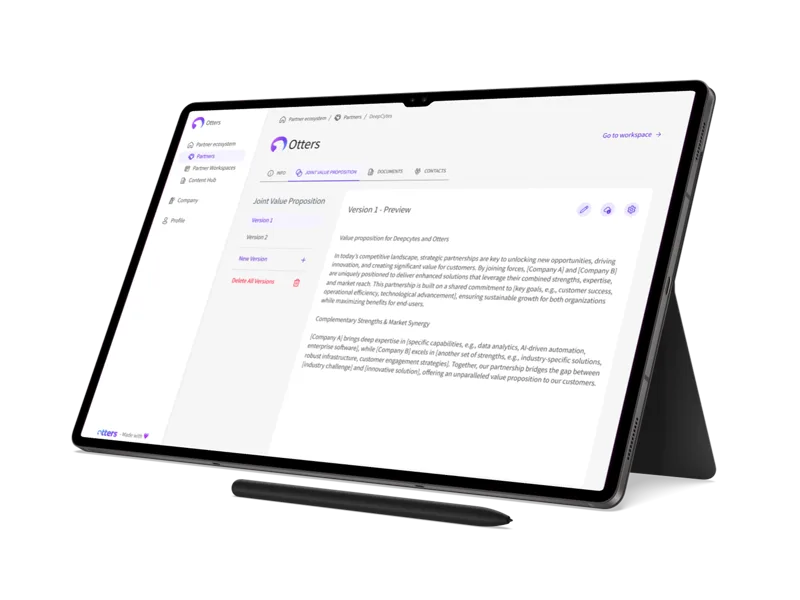
At a glance.
Four months from first interview to a feature partnership managers actively reached for.
Speed
Time to draft a Joint Value Proposition went from ~4 hours to ~30 minutes — same output, fraction of the effort.
Adoption
Most users adopted the feature and rated AI-generated JVPs equal to or better than the ones they used to write by hand.
Revenue
RPC grew as customers onboarded more partners — the partnership-driven growth motion the platform exists to enable.
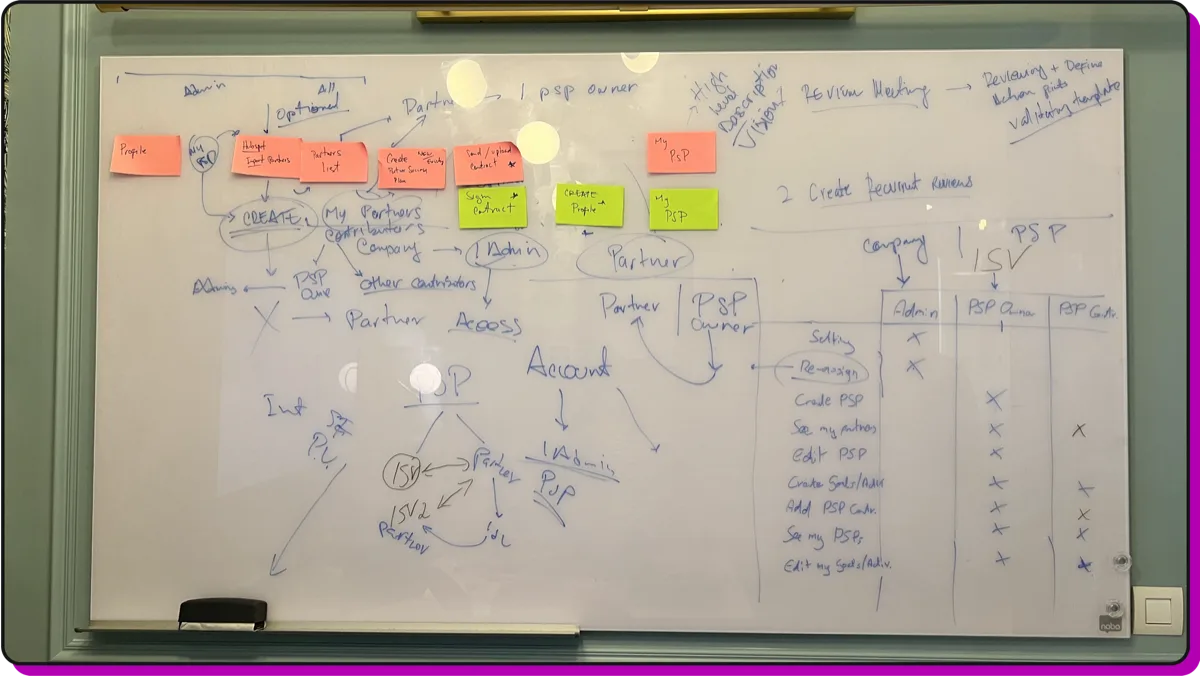
About the project.
Otters is a B2B platform for managing partner ecosystems — pipeline tracking, intelligence, and workflows for partnership managers and the sales teams behind them.
The brief: deliver an AI-powered solution that takes the most painful manual task in the workflow — writing Joint Value Propositions — and turns it into something a partnership manager can do between meetings instead of in place of them.
Context.
Role & team
- Lead Product Designer (end-to-end)
- Working with 2 developers and 1 ML engineer
- 4-month timeline: research → validation → implementation → tracking
- Web app, mobile responsive
Users & constraints
- Partnership managers, sales teams, enterprise clients
- Legacy data integrations across CRMs
- AI model limitations on first-pass quality
- Enterprise security and data-handling requirements
Manual partnership work was capping growth.
A four-hour task, stuck at the front of every outreach. The bottleneck wasn't strategy — it was the typing.
Crafting a tailored JVP for every potential partner takes time. Partnership managers were limited in how many partners they could even start a conversation with — which meant fewer chances to find the ones actually worth working with.
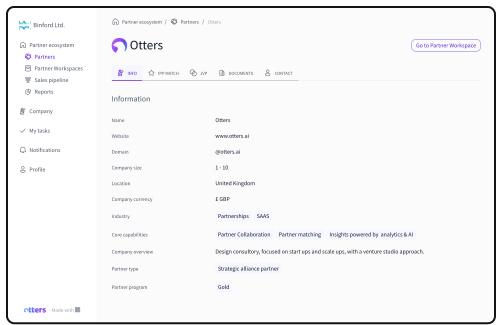
In interviews, the same picture kept emerging: most of their week was data entry and partner research, with strategy squeezed into the gaps.
Validate first. Build second.
Before writing a line of feature code, we ran a concierge model — a custom GPT generating JVPs from real partnership data. The question was whether AI could match human quality. The answer landed in the survey.
01 — Interviews
Talked to the operators
13 interviews with VPs of partnerships, managers, and sales reps to map what their day actually looked like.
02 — Mapping
Mapped the workflow
Walked the full partner-acquisition flow end to end. Found the bottlenecks where automation would have the most leverage.
03 — Concierge
Concierge GPT prototype
Built a custom GPT taking partner profile, customer pains, and prior JVPs as inputs. Generated drafts good enough to send.
04 — Iteration
Iterated with users
Fed JVPs back to the partnership managers who'd be using the production version. Their edits became the training signal.
users rated AI-generated JVPs as equal to or better than the ones they'd been writing by hand.
more partner outreach reported by managers once the JVP step stopped eating their afternoons.
The new flow.
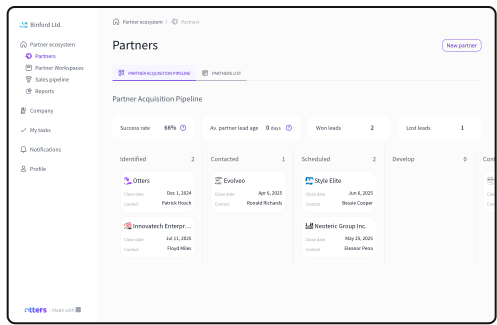
Three steps. The AI does the typing; the partnership manager keeps the strategy.
Add the partner
Partnership manager spots a potential partner and adds them to the pipeline with a few key details — starting with the website.
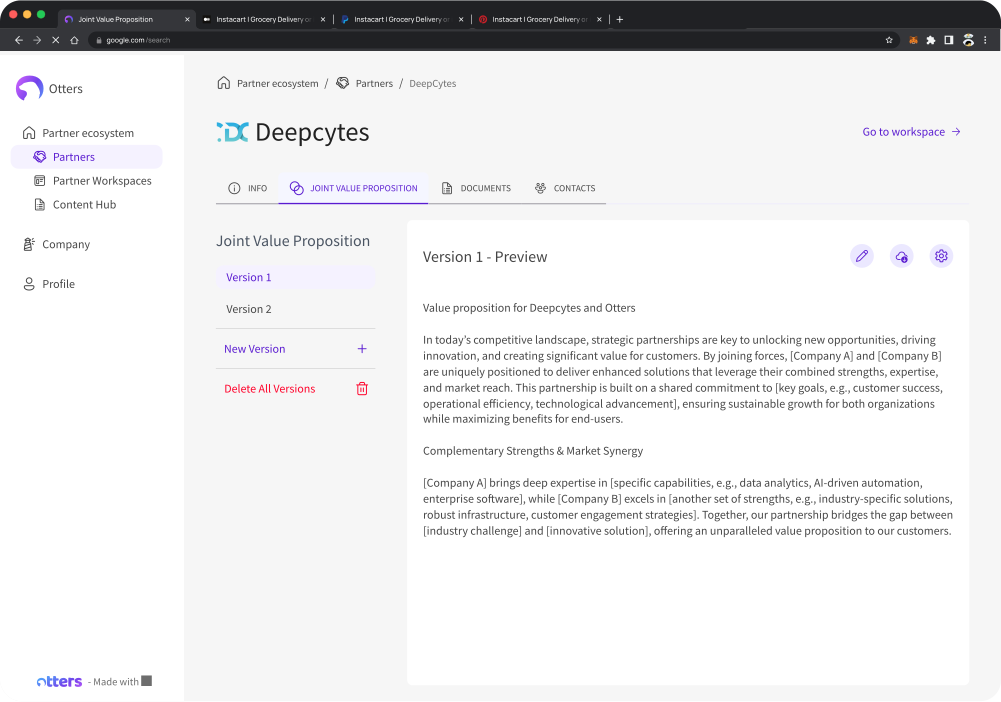
Generate the JVP
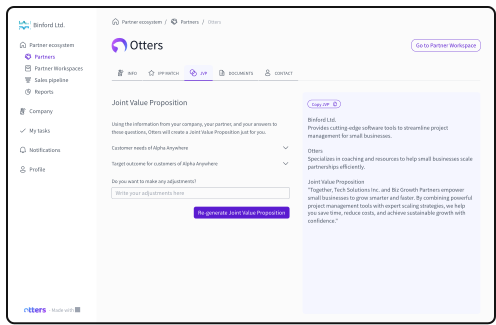
The AI drafts a tailored Joint Value Proposition, combining customer data with publicly available partner info. The manager edits, iterates, and ships.
Reach out
JVP in hand, the manager evaluates fit and approaches the partner with a clear, compelling proposal — not a generic template.
Improve over time
Every edit feeds the model. JVP quality keeps climbing as the system learns from how managers actually finish them.
Inside the feature.
Three screens, one path. Each step earns the next click.
Product-led growth.
Faster JVPs let customers scale partnerships. Scaled partnerships let Otters' revenue scale with them.
Faster completion
JVP creation went from ~4 hours to ~30 minutes — managers reported a 3× lift in their ability to engage potential partners.
Pipeline expansion
Customers grew their partnership pipelines, opening conversations with partners they would have skipped under the old workflow.
High adoption
88% of users adopted the feature; 8/9 rated AI-generated JVPs equal to or better than the manual ones.
Higher revenue per customer
RPC grew 17% as customers onboarded more partners — consistent with Otters' partnership-driven growth model.
The JVP generator gave back our afternoons. We went from picking the partners we had time to write for to picking the ones actually worth working with.VP of Partnerships · Otters customer
What I took away.
Start with the concierge model
Validate AI features with manual processes or a custom GPT before committing engineering. Cheap proof beats expensive ambiguity.
Quality over speed
AI can collapse hours into minutes — but users won't adopt it if quality slips. 8/9 users rated AI JVPs equal or better. That's the bar.
Edits are the training signal
Continuous user feedback and edit behavior turned the model into something that kept improving instead of plateauing at launch.